

China Top Shipping Tarp Manufacturers for Global Buyers
Global buyers choosing China-based suppliers need more than a low quotation. A Shipping Tarp must handle road spray, wind, repeated folding, and the rough edge of a cargo load. Fabric weight matters, but so do coating consistency, reinforced hems, seam construction, and well-placed grommets. Small details show up later.
For this guide, fictional procurement adviser Daniel Mercer offers a practical principle: “Judge a tarp by how it performs at its weakest seam, not by its thickest panel.” This is an illustrative expert viewpoint, not a verified quotation from a real industry professional. It points to a common sourcing blind spot: impressive material specifications cannot compensate for uneven workmanship. Buyers should request clear product data, sample photos, and inspection records, then compare like with like.
Look closely at customization options. A tarp sized for a flatbed should have suitable tie-down spacing, not merely the right overall dimensions. Ask how suppliers control batch variation and protect finished goods during packing. A sample is useful. It is not proof of every shipment.
This outline will help readers assess manufacturers, compare materials, check quality practices, and ask sharper questions before ordering. It will also acknowledge a real limitation: factory claims can be difficult to verify from a distance. Careful checks reduce uncertainty, but they do not erase it.
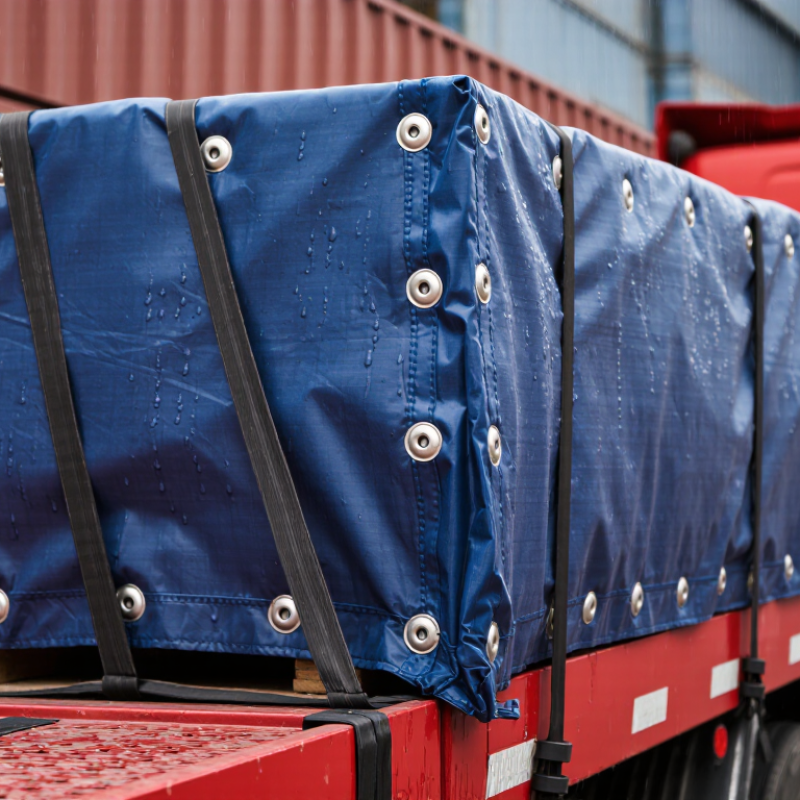
What Shipping Tarps Are and How Global Buyers Use Them
A shipping tarp is a flexible, weather-resistant cover that protects cargo during transport and temporary storage. It may cover palletized goods on a flatbed, machinery in a yard, or materials awaiting container loading. Buyers specify fabric, coating, dimensions, seam strength, and tie-down points to suit the cargo and route. Common choices include woven polyethylene and PVC-coated polyester, which differ in weight, abrasion resistance, cost, and reuse potential. Details matter. Poorly placed eyelets can tear in strong wind. A loose cover can collect water.
UNCTAD’s Review of Maritime Transport 2024 reports that seaborne trade reached 12.3 billion tonnes in 2023, following 2.4% growth. That figure measures trade, not tarp demand. Still, it shows why cargo protection must work across ports, road journeys, and temporary storage. Global buyers often request UV resistance, reinforced hems, documented strength ratings, and clear inspection criteria. Yet written specifications can miss local handling habits. A cover tested for rain may still fail when sharp cargo corners rub against it. Trialing samples on actual loads is unglamorous, but useful.
China Top Shipping Tarp Manufacturers for Global Buyers - What Shipping Tarps Are and How Global Buyers Use Them
| Tarp Type or Buyer Consideration | Typical Construction or Specification | Common Shipping Use | Advantages | Points to Check Before Ordering |
|---|---|---|---|---|
| What a shipping tarp is | A flexible protective cover made from coated or woven material, often finished with reinforced edges and attachment points. | Covering cargo during storage or transport, including loads carried on flatbed vehicles. | Helps shield cargo from rain, dirt, and some exposure to sunlight when correctly selected and secured. | Choose the material and construction for the cargo, transport method, weather exposure, and handling conditions. |
| PE (polyethylene) tarp | Woven polyethylene fabric, commonly laminated or coated; specifications vary by product. | General-purpose outdoor covering and temporary protection for packaged or stored goods. | Typically lightweight, flexible, and easy to handle. | Confirm fabric weight, coating, edge reinforcement, UV resistance, and whether the tarp is intended for repeated transport use. |
| PVC-coated polyester tarp | Polyester fabric coated with polyvinyl chloride (PVC); may include reinforced hems and welded seams. | Reusable covers for transport and industrial applications where a tougher, more durable cover is required. | Can provide a durable, water-resistant cover; performance depends on fabric, coating, seams, and workmanship. | Check finished weight, coating thickness, seam construction, flexibility in the expected temperature range, and repair options. |
| Canvas tarp | Woven fabric, commonly cotton or a cotton blend; treatments and water resistance differ by product. | Selected cargo or equipment covers where a breathable woven cover is suitable. | Breathability can help reduce trapped condensation compared with some non-breathable covers. | Check treatment, water resistance, drying requirements, and suitability for the cargo and expected weather. |
| Flatbed cargo tarp | Heavy-duty cover configured to suit a load and vehicle; may include reinforced corners, flaps, straps, or grommets. | Covering freight on open flatbed trailers, subject to the carrier’s securement procedures. | Can be selected or configured to cover different load shapes and exposure areas. | Measure the load and account for the cover’s drop, overlap, and fastening method; follow applicable cargo-securement rules. |
| Size and fit | Available dimensions vary; custom sizes may be specified by finished length and width. | Matching a tarp to cargo, palletized goods, equipment, or a vehicle deck. | A suitable fit can reduce uncovered areas and make securement more practical. | Confirm finished dimensions, tolerance, required overlap, corner shape, and whether measurements refer to the cut size or finished size. |
| Edges and attachment points | Common details include hemmed edges, grommets, D-rings, webbing, or sewn or welded reinforcements. | Providing points for tying down or tensioning a cover. | Reinforced details can help distribute tension when properly designed and used. | Check spacing, material, reinforcement, and compatibility with the planned ropes or straps; avoid excessive or uneven tension. |
| Weather and UV exposure | Resistance depends on the base fabric, coating or treatment, seams, and product specification. | Outdoor transport or storage in changing weather conditions. | The appropriate specification can help protect cargo from environmental exposure. | Ask for the stated water-resistance and UV-resistance properties, test basis if available, and any care or service-life guidance. |
| Safety and cargo securement | A tarp is a cover, not a substitute for load restraint or vehicle securement equipment. | Used alongside suitable tie-downs and the carrier’s approved securement method. | Proper covering can protect cargo while allowing the load to be secured separately. | Follow local transport regulations and carrier procedures; ensure the cover cannot loosen, obstruct visibility, or create a road hazard. |
| Global sourcing checks | Requirements can include material details, finished dimensions, color, packaging, labeling, and inspection criteria. | Comparing products for import, distribution, or project procurement. | Clear specifications make quotations and sample evaluation easier to compare. | Request a written specification, confirm sample approval and tolerances, and verify packing, shipping terms, and applicable import requirements. |
Note: Specifications and performance vary by product. Confirm the details for the particular tarp and ensure cargo is secured in accordance with applicable transport requirements.