
Top Wireless Lock Manufacturers for Global Buyers
Choosing a Wireless Lock manufacturer is not simply a comparison of prices, apps, or polished product images. Global buyers need dependable access control in hotels, offices, rental homes, campuses, and industrial facilities. A lock may look advanced, yet fail under weak connectivity, poor battery maintenance, or unclear installation guidance. Details matter.
Nico Delvaux, President and CEO of ASSA ABLOY, has emphasized, “The future of access is digital.” That direction is clear, but digital access must still work in physical places. This guide examines leading Wireless Lock manufacturers through practical purchasing criteria, including product reliability, security architecture, battery performance, communication protocols, integration options, and after-sales support. It also considers regional certifications, installer networks, software updates, and warranty responsiveness. These factors often matter more than a clever mobile interface.
There is no universal winner. A manufacturer serving luxury hotels may not suit a small property manager or a high-traffic workplace. Some suppliers offer strong hardware but limited cloud compatibility. Others provide flexible platforms but weaker local support. That trade-off deserves honest attention. Buyers should request test units, review failure procedures, and confirm performance in metal doors, outdoor conditions, and unstable networks. One missed detail can become a daily operational problem.
This overview is designed for informed comparison, not automatic endorsement. It combines industry experience, technical evaluation, and buyer-focused evidence to identify manufacturers worth serious consideration. Trust is earned slowly.
Wireless Lock Technology and Its Main Product Categories
Wireless Lock Technology and Its Main Product Categories
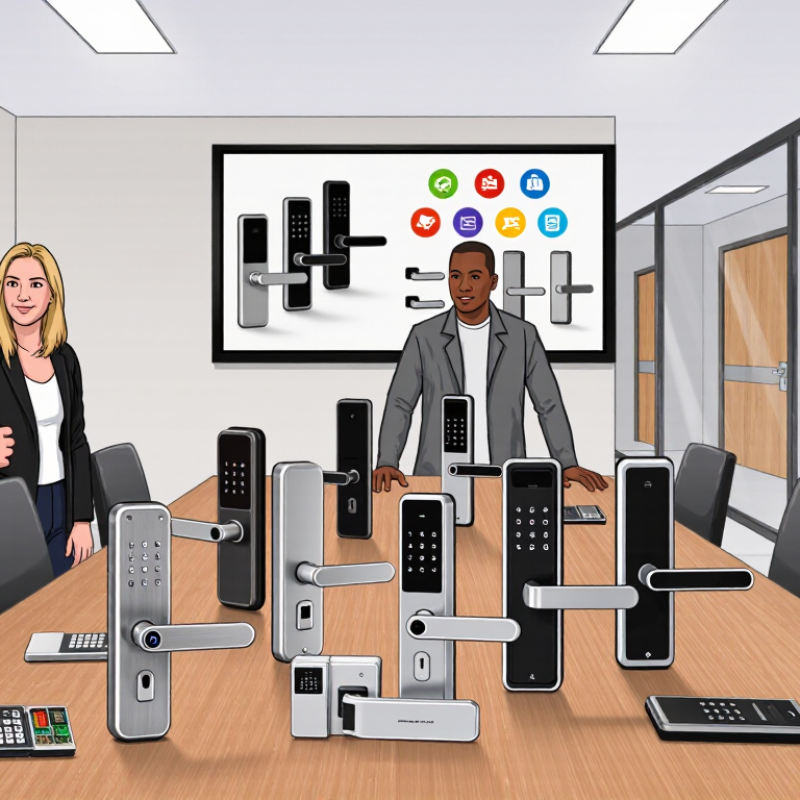
Wireless locks combine electronic credentials, sensors, and remote communication without traditional wiring. Common connections include Bluetooth, Wi-Fi, Zigbee, Z-Wave, and NFC. Each option affects battery life, operating distance, installation effort, and data security. Bluetooth suits apartments and offices where users unlock doors with nearby phones. Wi-Fi supports remote monitoring, but it may consume more power. Zigbee and Z-Wave work well in larger connected-property systems.
The main product categories include residential door locks, hotel room locks, cabinet locks, smart padlocks, and commercial access-control units. Residential models often use PIN codes, fingerprints, cards, or mobile applications. Hotel locks usually support temporary credentials and audit records. Cabinet locks protect medicines, tools, documents, and equipment in controlled workplaces. Smart padlocks are useful for gates, storage areas, and shared facilities, although exposed weather can reduce reliability. Small details matter.
Global buyers should check encryption, emergency power options, firmware updates, and compatibility with local door structures. A lock may appear advanced but fail during a network outage or low-battery event. Mechanical override systems still deserve careful testing. Installation quality also changes performance; a misaligned latch can cause repeated unlocking errors. Certification requirements vary by market, so technical documents should be verified before purchasing. Remote control is convenient, but it can create unnecessary dependence on cloud services. That trade-off deserves honest review.
| Product Category | Typical Application | Common Wireless Technology | Authentication Methods | Typical Power Source | Typical Operating Range | Common Protection Level | Key Buyer Considerations |
|---|---|---|---|---|---|---|---|
| Electronic Cabinet and Locker Locks | Office lockers, employee storage, schools, gyms, hospitals and parcel cabinets | Bluetooth Low Energy NFC 2.4 GHz wireless | PIN code, RFID card, NFC credential, mobile application, administrator key | Alkaline batteries, lithium batteries or low-voltage DC power | Usually short range; approximately 1–10 m for Bluetooth-connected access, depending on walls and interference | Indoor models commonly use basic dust and splash protection; outdoor models may be rated IP65 or higher | Audit records, emergency override, battery replacement, locker assignment and centralized administration |
| Smart Residential Door Locks | Apartments, houses, rental properties and residential entrances | Bluetooth Low Energy Wi-Fi Zigbee Thread | Keypad PIN, fingerprint, mobile application, physical key, NFC or temporary passcode | AA or AAA batteries are common; some models support rechargeable battery packs or wired backup power | Bluetooth access is generally local; Wi-Fi-enabled models can support remote access when connected to a gateway or home network | Exterior escutcheons commonly target weather resistance; the exact IP rating varies by construction and installation | Door thickness, cylinder compatibility, retrofit requirements, low-battery warning and mechanical emergency access |
| Hotel and Hospitality Door Locks | Guest rooms, serviced apartments, resorts and staff-only areas | RFID NFC Bluetooth Low Energy | Contactless card, mobile room key, PIN, staff credential and mechanical override | Replaceable batteries or hardwired low-voltage power, depending on door architecture | Mobile credentials normally operate locally through Bluetooth; property management integration may require gateways | Indoor and semi-outdoor options are available; fire-door and escape-route requirements must be checked locally | Compatibility with hotel management systems, offline operation, access-event logs, privacy and rapid credential revocation |
| Commercial Cylinders and Escutcheons | Offices, commercial buildings, schools, clinics and multi-tenant properties | Bluetooth Low Energy NFC RFID | Smartphone credential, contactless card, keypad, staff token and mechanical key | Replaceable batteries are common; wired versions can use building access-control power supplies | Local mobile communication is typically short range; network connectivity depends on gateway placement | Indoor versions may have limited sealing; exterior versions require weather-resistant housings and suitable door hardware | European or North American cylinder format, fire-rating compatibility, master-key strategy and integration with access software |
| Wireless Electric Strikes | Office doors, gates, apartment entrances and controlled passage points | Bluetooth Low Energy Wi-Fi Proprietary RF | Mobile application, access card, keypad, remote release button or integrated access controller | Usually low-voltage wired power; wireless control can be combined with a local battery module | Wireless control distance varies by receiver and building construction; wired power remains common for reliable duty cycles | Indoor and outdoor housings are available; outdoor installations should use an enclosure rated for expected water and dust exposure | Fail-safe versus fail-secure behavior, door-frame fit, current draw, holding force and emergency-egress compliance |
| Wireless Padlocks | Gates, utility cabinets, construction sites, warehouses, containers and equipment | Bluetooth Low Energy Cellular LoRaWAN NFC | Mobile application, PIN, fingerprint, NFC credential or remote authorization | Replaceable or rechargeable battery; cellular and long-range models require careful power management | Bluetooth is generally local; cellular and long-range versions can transmit status over wider areas where network coverage exists | Outdoor models commonly emphasize dust and water resistance; some products are designed for high protection levels such as IP67 | Shackle material, corrosion resistance, tamper detection, offline operation, temperature range and battery life |
| Gate and Barrier Locks | Residential gates, parking areas, campuses, logistics yards and restricted facilities | Bluetooth Low Energy Wi-Fi Cellular Long-range RF | Mobile credential, remote command, keypad, RFID card, vehicle tag or access-control system | Wired DC power is common; solar-assisted battery systems are used where mains power is unavailable | Range depends on antenna, site layout and network infrastructure; cellular models can support remote management | Outdoor products commonly require weather-resistant construction, corrosion protection and drainage design | Gate weight, duty cycle, manual release, backup power, vehicle-flow management and local safety regulations |
| Smart Cabinet and Industrial Enclosure Locks | Data cabinets, electrical enclosures, vending machines, tool storage and industrial equipment | Bluetooth Low Energy RFID NFC Sub-GHz RF | RFID card, mobile application, PIN, service credential or centralized authorization | Battery-powered or integrated with the enclosure's low-voltage control system | Usually local access range; long-range status reporting requires a gateway or dedicated network module | Protection level is application-specific; industrial installations may require sealed housings and corrosion-resistant materials | Locking force, vibration resistance, tamper monitoring, service access, cable routing and environmental temperature |
| Fleet and Delivery Compartment Locks | Delivery vans, service vehicles, parcel compartments and mobile storage units | Bluetooth Low Energy Cellular GNSS integration | Mobile application, driver credential, one-time code, remote dispatch authorization or NFC | Vehicle power, rechargeable battery or replaceable battery pack | Bluetooth is used for nearby unlocking; cellular connectivity supports remote status and event reporting where coverage is available | Vehicle-oriented designs normally require resistance to vibration, dust, water and temperature variation | Event timestamps, location linkage, offline access, tamper alerts, vehicle power integration and fleet-management APIs |
| Long-Range Connected Locks | Remote utility assets, rural gates, infrastructure cabinets and distributed equipment | LTE-M NB-IoT LoRaWAN Sub-GHz RF | Remote authorization, mobile credential, PIN, NFC service key or scheduled access policy | Large-capacity battery, rechargeable battery or solar-assisted power system | Designed for wider-area communication; actual coverage depends on local cellular or private-network availability | Outdoor products often prioritize sealed housings, corrosion resistance and operation across broad temperature ranges | Network availability, subscription cost, battery replacement interval, data security, remote firmware updates and offline fallback |
| Technical ranges and features are representative market characteristics rather than manufacturer-specific specifications. Final selection should be verified against local building, fire, accessibility, cybersecurity and data-protection requirements. | |||||||