
What Are the Top OSB Types from China Suppliers in 2026?
Choosing the right OSB starts with the job it must do. In 2026, buyers comparing Chinese suppliers may encounter general-purpose panels, load-bearing grades, moisture-resistant options, and tongue-and-groove boards. Each serves different needs. A roof deck, wall sheathing, and subfloor do not face the same loads or installation conditions.
Grade labels help, but they do not tell the whole story. Thickness, panel dimensions, edge profile, bonding system, and declared performance all matter. A dependable China Osb Supplier should provide current technical data and clear product identification. Ask for documentation that matches the exact panel being quoted, not a similar product from a broad catalogue. Details matter.
This guide introduces common OSB types and explains where buyers typically use them. It also highlights practical checks, such as confirming thickness tolerance, surface finish, and suitability for the intended environment. If a panel will face moisture, verify its stated rating and follow the manufacturer’s installation guidance; “moisture-resistant” does not mean waterproof. That distinction is easy to overlook.
Supplier claims deserve careful review. Request samples when appearance or machining quality matters, and compare specifications before judging price alone. Test reports and certifications can support a purchase decision, but check their scope, issuing body, and validity. Product ranges change, and specifications may vary between factories. This overview is a starting point, not a substitute for project-specific engineering advice. A little caution now can prevent a poor fit later.
How OSB Is Made and Classified
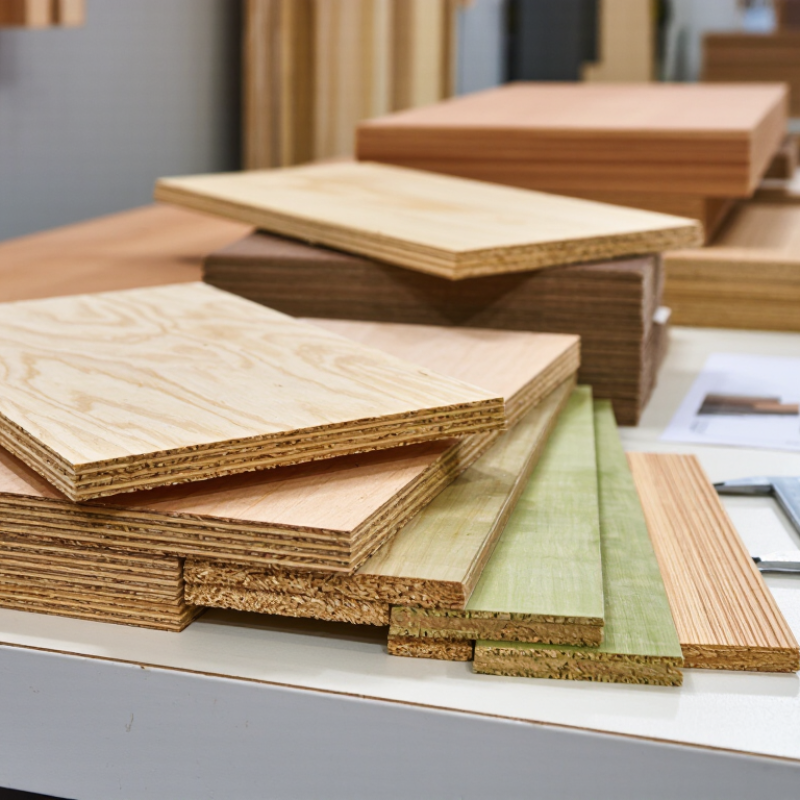
OSB begins with peeled wood strands, typically cut into long, narrow flakes. Manufacturers dry them, blend them with resin and wax, then arrange them in layers. The outer layers usually run lengthwise; the inner layer runs across them. This orientation gives the panel strength in both directions. A formed mat is hot-pressed into a dense board, then trimmed and graded. The edges reveal the layered structure.
EN 300 classifies panels as OSB/1, OSB/2, OSB/3, or OSB/4. OSB/1 is for non-load-bearing use in dry conditions; OSB/2 is load-bearing in dry conditions. OSB/3 and OSB/4 are designed for load-bearing use in humid conditions, with OSB/4 intended for heavier duties. “Humid” does not mean waterproof. That distinction is easy to miss. EN 300:2006 sets a minimum major-axis bending strength of 18 N/mm² for OSB/3 panels over 18 mm and up to 25 mm thick. Buyers should compare the declared class, thickness, and test data—not just the board’s appearance. Two panels can look alike. They may perform differently.

The Main OSB Types Available from China Suppliers in 2026
China suppliers commonly classify OSB by performance class, not appearance. Under EN 300, OSB/1 is for non-load-bearing use in dry conditions; OSB/2 is load-bearing in dry conditions. OSB/3 suits load-bearing applications in humid conditions, while OSB/4 is designed for heavier loads in humid conditions. The class matters more than a smooth face. Check the technical sheet for thickness, strength, and moisture-related performance before specifying panels.
FAO’s Global Forest Products Facts and Figures 2023 reported worldwide wood-based panel production of about 401 million cubic metres in 2022. This figure covers several panel products, not OSB alone, but it shows the scale of the broader supply sector.
China suppliers may also offer sanded, grooved, laminated, or custom-cut OSB; these describe surface treatments or formats, not EN 300 classes. For example, a grooved panel may still be OSB/3, and its edge profile does not establish its structural rating. Ask for test reports linked to the exact product and intended use.
One detail is easy to overlook: “moisture resistant” does not mean waterproof. Performance can vary with adhesive, thickness, and manufacturing controls, so generic descriptions deserve a closer look.
How OSB Types Differ in Strength and Moisture Resistance
OSB types differ mainly in their intended load and exposure conditions, not simply in how “strong” they feel. OSB/1 is for non-structural use in dry interiors, while OSB/2 is designed for load-bearing use in dry conditions. OSB/3 combines load-bearing capacity with suitability for humid conditions, making it a common choice for covered construction. OSB/4 is intended for heavier structural demands in humid conditions. Check the stated standard and product documentation, since grade labels alone do not show every performance detail.
Moisture-resistant does not mean waterproof. A damp board may tolerate temporary exposure, yet prolonged wetting can cause swelling, especially along cut edges. Strength also depends on thickness, panel span, support spacing, and installation; a thicker sheet is not automatically right for every floor or roof. Measure carefully. When comparing China suppliers, request current test reports, declared grade, thickness tolerance, and guidance for the intended application. A practical check is to compare panel specifications with the project drawings, then confirm edge sealing and storage instructions. I would not rely on a quick hand-feel test: it can reveal roughness, but not dependable structural performance.
Common Uses of Each OSB Type
OSB grades are defined by load capacity and moisture conditions, not by appearance. EN 300 classifies OSB/1 for general use in dry interiors, such as cabinet backs and packaging. OSB/2 is load-bearing in dry conditions, so it suits interior floors and wall panels. OSB/3 handles structural loads in humid conditions and is widely used for roof, wall, and floor sheathing. OSB/4 is intended for heavier structural loads in humid conditions, including demanding floor assemblies. “Humid” does not mean permanently exposed to rain.
The details matter. APA’s Engineered Wood Construction Guide identifies common sheathing thicknesses such as 7/16 inch for walls and 23/32 inch for floors; the right choice depends on span ratings and the design. On site, check panel grade stamps and support spacing before installation. A thicker sheet is not automatically the safer choice. USDA Forest Products Laboratory guidance also describes how moisture changes can affect wood-based panels, so protect stored sheets from standing water and allow for installation conditions. It is easy to overread a grade label. Select for the actual load and exposure, and verify the project specification.
What Are the Top OSB Types from China Suppliers in 2026? — Common Uses of Each OSB Type
Common uses: OSB/1 is for general-purpose, non-load-bearing use in dry conditions, such as interior fittings and packaging. OSB/2 is for load-bearing use in dry conditions, including structural panels for floors, roofs, and walls. OSB/3 is for load-bearing use in humid conditions, commonly as structural sheathing. OSB/4 is for heavy-duty load-bearing use in humid conditions.
The chart summarizes EN 300 type classifications: 1 = yes, 0 = no. Check the product’s technical datasheet and local building requirements for specific applications.
How to Compare OSB Grades, Standards, and Supplier Quality
What Are the Top OSB Types from China Suppliers in 2026?
Compare grades, standards, and supplier quality before comparing prices. EN 300 classifies OSB by use: OSB/1 for general dry conditions, OSB/2 for load-bearing dry conditions, OSB/3 for load-bearing humid conditions, and OSB/4 for heavy-duty humid conditions. In North American markets, buyers may see PS 2 or CSA O325 references instead. These systems are not interchangeable labels; request documentation against the standard specified for your project. Grand View Research estimated the global OSB market at USD 25.57 billion in 2023, reflecting a broad and competitive supply base—not proof that any individual panel meets your needs.
For a useful comparison, match panel thickness and intended span, then check the declared performance values. APA’s Rated Sheathing guidance includes span ratings such as 24/16, indicating different maximum support spacings for roof and floor applications. Ask suppliers for current test reports, mill certificates, batch traceability, and details of panel construction. Confirm that the paperwork names the same factory and product being quoted. I would not treat a polished PDF as proof; documents can be incomplete, and that is easy to overlook. Check edge condition, thickness consistency, and labeling on actual samples.
Tips: Request one sample from the production lot, not only a showroom piece. Compare its thickness at several points, inspect for swollen edges, and ask how moisture resistance is verified. Small checks matter. Some buyers focus too heavily on price. I’d reconsider that habit.
What Are the Top OSB Types from China Suppliers in 2026? — How to Compare OSB Grades, Standards, and Supplier Quality
Use this comparison to match the OSB grade to its intended service conditions and to check that a supplier’s product claims are supported by relevant test reports. Grade descriptions below follow the European EN 300 classification; grades are not interchangeable with thickness or surface-finish options.
| OSB type | EN 300 classification | Intended loading and conditions | Typical applications | What to verify with the supplier | Key limitation |
|---|---|---|---|---|---|
| OSB/1 | General-purpose boards and boards for interior fitments; non-load-bearing use in dry conditions. | Non-load-bearing; dry service conditions. | Interior panels, furniture components, and other non-structural uses where the specified conditions are suitable. | Confirm that the technical sheet identifies OSB/1 and the intended dry-use application. Check declared thickness, dimensions, and test documentation. | Not the appropriate EN 300 class when structural load-bearing performance is required. |
| OSB/2 | Load-bearing boards for use in dry conditions. | Structural loading; dry service conditions. | Structural sheathing or components in dry interior environments, when the design and local building requirements permit. | Request evidence for the stated grade and the mechanical properties required by the project. Confirm the product’s declared thickness and intended end use. | Dry-use classification; do not assume suitability for humid conditions from the grade name alone. |
| OSB/3 | Load-bearing boards for use in humid conditions. | Structural loading; humid service conditions. | Commonly specified for building applications such as roof, wall, and floor sheathing where the design calls for this class. | Check the OSB/3 declaration, relevant performance data, panel dimensions, and instructions for storage, installation, and protection during construction. | “Humid conditions” does not mean waterproof or suitable for continuous outdoor exposure without appropriate design and protection. |
| OSB/4 | Heavy-duty load-bearing boards for use in humid conditions. | Higher-duty structural loading; humid service conditions. | Projects requiring the heavy-duty load-bearing class, subject to structural design and applicable building requirements. | Request grade-specific test evidence and the performance values relevant to the design. Confirm that the report applies to the same product construction and thickness range. | Higher class does not remove the need for engineering checks, correct installation, or moisture protection. |
Standards and supplier-quality checks
| Check | Relevant standard or evidence | How to compare offers |
|---|---|---|
| Product grade | EN 300 defines OSB/1, OSB/2, OSB/3, and OSB/4. For Chinese-market product documentation, ask whether the product is declared or tested to the applicable edition of GB/T 41715. | Compare the named standard, grade, product description, and intended conditions. Do not treat “structural,” “premium,” or a thickness label as a grade unless supported by documentation. |
| Test methods | GB/T 17657 is a test-method standard for physical and mechanical properties of wood-based panels. | Check which properties were tested, the test method, sample dimensions, product identification, and report date. Request reports that match the offered panel construction and specification. |
| Formaldehyde emissions | GB 18580-2017 sets a formaldehyde-emission limit for wood-based panels and their products. GB/T 39600-2021 defines E1, E0, and ENF emission classifications: E1 ≤ 0.124 mg/m³, E0 ≤ 0.050 mg/m³, and ENF ≤ 0.025 mg/m³, measured using the 1 m³ chamber method. | Request the test method, result, classification, and report for the specific product. Emission classification is separate from OSB structural grade; confirm the destination market’s requirements. |
| Dimensions and finish | Supplier specification and applicable product requirements; options may include thickness, panel size, sanded surfaces, or profiled edges. | Compare stated nominal dimensions, tolerances, edge profile, surface condition, and packaging. Ensure these options do not obscure the declared OSB grade. |
| Production consistency | Product-specific quality-control records, inspection results, and traceable production or batch identification. | Ask how the shipment is identified and inspected, and whether production checks cover the same product and specification as the quotation. |
| Export and project suitability | Destination-country regulations, project specifications, and any required conformity or certification documents. | Verify document validity and scope with the issuing body where applicable. Confirm the grade, emissions, dimensions, and intended use against the project specification before ordering. |
Comparison note: OSB/1 to OSB/4 describe performance classes, not a universal ranking of manufacturers. A higher-numbered class is not automatically the best choice for every project. Select the class and panel specification required by the design, service conditions, and destination-market rules; obtain current, product-specific documentation before purchase.