

What Are the Top Types of Car Aroma Diffusers?

Choosing a Car Aroma Diffuser is not just about picking a scent. The device sits close to the driver, often for hours, so control, placement, and ease of cleaning matter. Vent clips are compact and simple. Hanging diffusers need no power. USB-powered and ultrasonic models offer more control, but add components that may need regular care. Small details count: a clip that blocks an air vent or a bottle that leaks can quickly make a pleasant cabin feel cluttered.

Market data offers context, not a verdict. Grand View Research estimated the global air freshener market at about USD 13.3 billion in 2023 and forecast growth through 2030. That figure covers air fresheners broadly, not car aroma diffusers alone—a distinction product marketing can blur. It signals interest in scent products, but does not prove that every diffuser type performs equally well in a moving vehicle.

Scent perception matters, too. Sensory neuroscientist and smell researcher Dr. Rachel Herz has said, “Smell is the only sense that has a direct connection to the emotional centers of the brain.” Her work offers useful context, though it is not a car-diffuser performance test. No single design suits every driver. This guide compares the main types by power source, scent delivery, upkeep, and everyday practicality, so readers can weigh real trade-offs rather than follow fragrance claims alone. A little skepticism helps.
What Are the Top Types of Car Aroma Diffusers?

How Car Aroma Diffusers Disperse Fragrance

What Are the Top Types of Car Aroma Diffusers?

How Car Aroma Diffusers Disperse Fragrance

Car aroma diffusers spread fragrance in different ways. Vent-clip models use the car’s airflow to carry scent from a scented pad or cartridge into the cabin. With the fan running, fragrance may travel farther; with the vents off, it often fades. The effect depends on airflow, cabin size, and how strong the scent material is. Small details matter.

Passive diffusers rely on evaporation. Fragrance slowly leaves a porous surface, such as felt or wood, without a fan or power source. Electric models may use a small fan, heat, or a vibrating element to help disperse fragrance. Some create a fine mist, while others simply move scented air. These methods are not interchangeable, and a mist does not always mean stronger or longer-lasting fragrance. One limitation is easy to overlook: warm, sunny cabins can change how quickly scents evaporate.

Tips: Start with a low setting, if adjustable. Keep the diffuser clear of controls and your direct line of sight. Give the scent a few minutes to spread before adding more. Too much can feel distracting, even when the fragrance smells pleasant outside the car. A little restraint helps.

How Vent-Clip Diffusers Use Airflow

What Are the Top Types of Car Aroma Diffusers?

How Vent-Clip Diffusers Use Airflow

Vent-clip diffusers sit directly on an air-conditioning vent. Moving air passes over a scented pad or cartridge and carries fragrance into the cabin. Air does the work. With the fan off, scent may fade; with strong airflow, it can become noticeable quickly. Warm air may also change how strongly the fragrance seems to spread.

Placement matters. A clip that blocks part of the vent can disturb the air stream, while a loose fit may rattle on rough roads. Check that it does not interfere with vent controls, and start with a low fan setting. The effect varies with cabin size, temperature, and airflow direction. It is not perfectly predictable.

The U.S. Environmental Protection Agency’s Report to Congress on Indoor Air Quality notes that concentrations of some pollutants in indoor environments can be two to five times outdoor levels. That finding concerns indoor environments generally, not cars or fragrance devices. It is a useful reminder, though: fragrance does not clean or replace cabin ventilation. Use a vent diffuser sparingly, keep vents unobstructed, and follow the device’s care instructions. A subtle scent is often easier to live with.

How Hanging and Passive Diffusers Release Scent

Hanging diffusers release scent through slow evaporation. Many use a small porous wood, ceramic, or fiber element soaked with fragrance. As the car moves, air carries scent molecules from the surface into the cabin. Warm sunlight can speed evaporation, while a cool, still cabin may make the aroma faint. Gentle airflow helps; strong heat can make the scent fade sooner than expected. The change is gradual. A hanging unit should sit securely and stay clear of the driver’s view, since even a small object can distract.

Passive diffusers work without a fan or powered heater. They may use a scented pad, porous stone, or gel in a holder, sometimes near an air vent. Vent airflow can spread fragrance quickly, but it may also create a strong burst when the fan starts. Without airflow, release usually depends on temperature and exposed surface area. Placement matters. A covered surface often releases less scent than an open one. These devices are simple, but their output is not perfectly steady; cabin heat, ventilation, and remaining fragrance all affect intensity. Follow care instructions, and stop using the diffuser if the odor causes irritation. The exact duration is hard to predict.

What Are the Top Types of Car Aroma Diffusers? - How Hanging and Passive Diffusers Release Scent

Diffuser Type How It Releases Scent Power Required Scent Control Typical Advantages Things to Consider
Hanging liquid diffuser Fragrance liquid evaporates through a porous stopper or insert. Some designs release more scent when the container is briefly inverted and the stopper becomes damp. None Usually limited; release depends on the liquid, exposed surface, airflow, and how the product is used. Simple to install and does not need a vent or electrical connection. Secure it so it cannot obstruct the driver’s view or swing into controls. Follow the instructions to avoid spills or contact with vehicle surfaces.
Passive vent clip Fragrance held in a scented insert, pad, or porous material evaporates. Air from the vehicle vent carries the scent into the cabin. None Often influenced by vent airflow; closing the vent or reducing airflow can reduce scent distribution. Compact and easy to position near an air vent. Its output can change with fan use and cabin temperature. Check that the clip fits securely and does not damage the vent.
Passive solid or gel diffuser Fragrance gradually evaporates from a scented solid or gel through an open surface or vents in its container. None Generally steady but not actively adjustable; airflow and temperature can affect how quickly fragrance is released. No liquid bottle to hang and no batteries or wiring are needed. Keep it upright and away from direct sunlight or hot surfaces, which may affect the material or scent release.
Passive scented card or paper diffuser Fragrance applied to absorbent paper or card evaporates directly into the surrounding air. None Usually low and gradual, with little direct control over release. Lightweight, straightforward to use, and does not rely on vehicle airflow. Keep it clear of the driver’s line of sight and replace it when its fragrance fades.
Electric heated diffuser An electrical heating element warms a fragrance material or oil, helping fragrance evaporate into the cabin. Yes; commonly powered through a vehicle outlet or USB connection, depending on the model. Some designs offer settings, though control options vary by product. Can provide more consistent release while powered and may offer adjustable operation. Requires a power source and should be used according to its instructions, especially around liquids and warm surfaces.
Electric nebulizing diffuser A small mechanism disperses fragrance oil as fine droplets or mist rather than relying only on passive evaporation. Yes; typically battery-powered or connected to a vehicle power source, depending on the design. Some models provide timed or intensity settings; features differ by model. Active dispersal can distribute fragrance without depending on vent airflow. May require charging or cleaning and should use only the type of fragrance material specified by the manufacturer.

How Electric and Ultrasonic Diffusers Operate

What Are the Top Types of Car Aroma Diffusers?

How Electric and Ultrasonic Diffusers Operate

Electric car diffusers use a power source, often a vehicle outlet or USB port, to spread fragrance. Some warm a scented material gently; others use a small fan to move air across a fragrance pad. The exact method depends on the device. A fan-based unit may release scent more noticeably when the cabin ventilation is running, while a heat-based unit can work without airflow. Check how a diffuser is powered and refilled before placing it in the car.

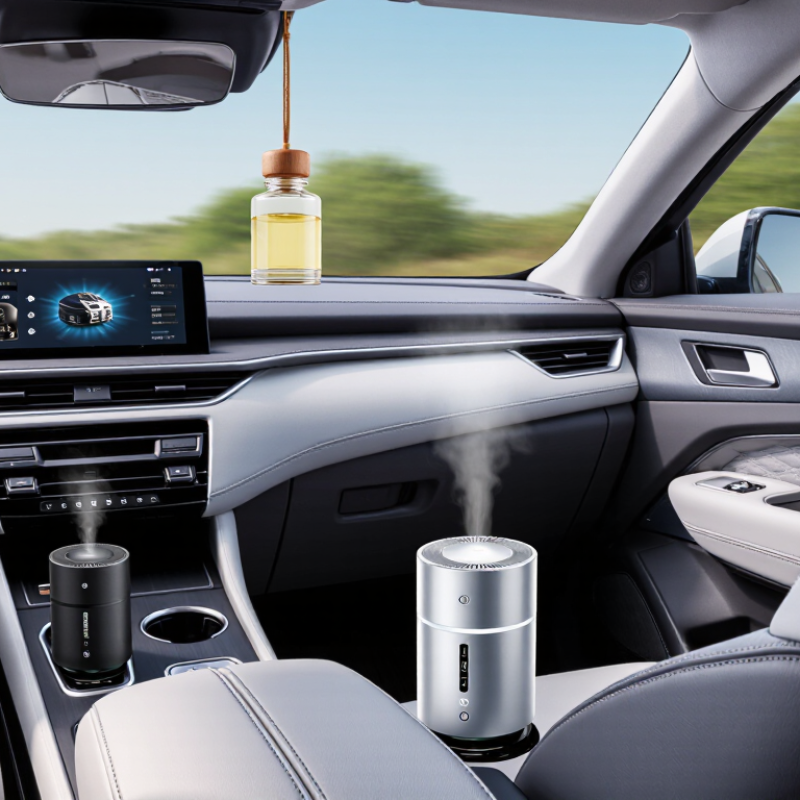
Ultrasonic diffusers work differently. A small vibrating plate breaks water and fragrance mixture into fine droplets, which rise as a cool mist. No heating is needed. The mist can be visible in sunlight, like a faint cloud near the dashboard. These devices generally need water and careful placement, since movement or sharp turns can cause spills. Keep liquid away from screens, switches, and other electronics.

The distinction is easy to miss. Both types can make a car smell stronger, but neither guarantees an even scent throughout the cabin. A diffuser tucked behind a seat may barely be noticed; one near an air vent can feel overpowering. Start with a short operating period and adjust the position or output. That small test matters, especially in a compact car.

How Nebulizing Diffusers Disperse Essential Oils

Among car aroma diffusers, nebulizing models work differently from water-based designs. They use airflow to break essential oil into tiny droplets, then release those droplets into the cabin. No water is added, and many models do not rely on heat. The scent can feel direct and noticeable. That matters in a small space.

Inside the device, a pump pushes air through a narrow opening near the oil. The moving air draws oil upward and disperses it as a fine mist. Output depends on the device, oil viscosity, and settings, so results can vary. Some units pulse intermittently; others run continuously. Not always ideal. A strong setting may use oil quickly or feel overpowering during a short drive.

Placement deserves care. Keep the diffuser stable and away from airbag zones, pedals, screens, and controls. Follow the device instructions, and check that its materials are suitable for essential oils. A small test on a hidden surface can help avoid damage. Ventilation also matters, especially for passengers sensitive to fragrances. Nebulizing diffusion is convenient, but more scent is not automatically better. Start with brief intervals and adjust gradually.

Scroll to Top